Odds are that, just like most people, you hear about curling once every two years when the Winter Olympics come around. Most people watch a few games, make a few off comments about how “That doesn’t look too hard,” then move on without even knowing how points are scored.
But, after reading this article, you’ll be able to understand the game and you may even find a new passion in the sport.
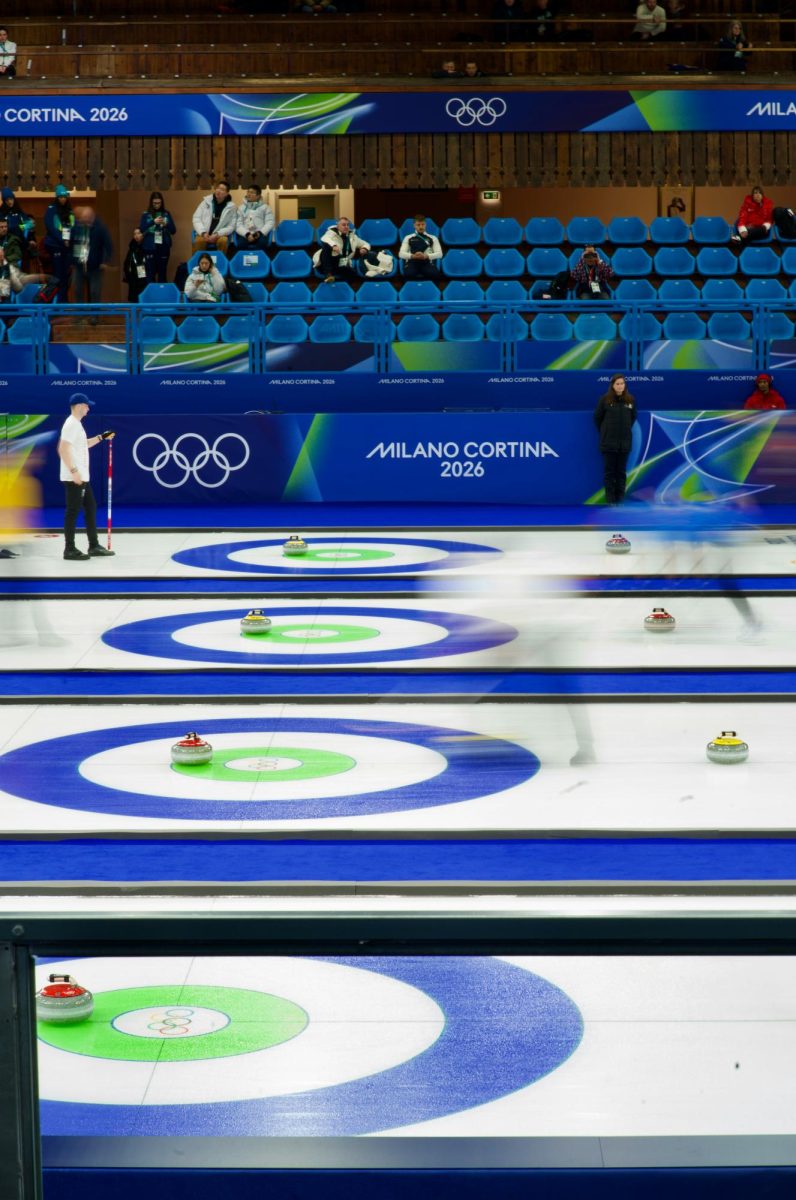
In curling there are two teams that compete to get their stones closer to the target, called the house, at the end of the sheet of ice to score points. They do this through taking turns pushing off of starting blocks to slide and add spin to 42 pound granite stones. These stones glide across a 146-foot sheet of special pebbled ice, with small bumps on its surface, which makes the stones slide further than on a standard sheet of ice. While the granite stones spin on the ice, they begin to curl in an arc, giving the sport its name.
After releasing the stone before the hogline (a denoted line at the start of the sheet) it is the skips job (team captain) to call out what the sweeper, the person who uses a specialized brush, to sweep the ice should do. From there, the sweeper’s job is to either increase the amount of distance the stone goes or the amount of spin that the stone has, both done by using a broom to melt the ice.
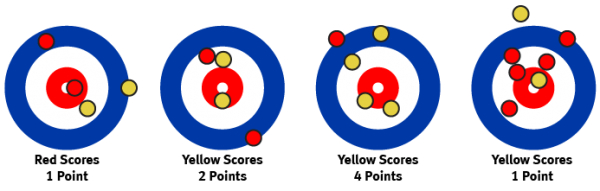
This is where the scoring comes in. To score points in each of the 6-10 ends, which is the equivalent of a round, depending on the discipline of curling. For each of these rounds, curlers have eight stones to throw at the house. The more stones one team has closer to the center than their opponent allows them to get one point for each of those stones, as long as at least one stone is in the house.
Beyond the basics of how to play there’s a complexity to curling that is not often associated for casual viewers. Behind each throw is strategy, whether it’s playing something in front of the house to try and block future attacks, called a guard, or a draw, where the stone stops in front or inside of the house to try and get some points on the board. However these draws can often be taken out by shots called peels that hit away opponents stones.
Despite the lack of knowledge surrounding the sport, there are nearly 200 curling clubs in the United States according to USA Curling, and there is even a curling club in Portland. Just west of Ida B. Wells-Barnett High School is Evergreen Curling Club in Beaverton.
These clubs are often great places to learn how to play curling and learn fast, as curling is an easy to learn sport for any age, allowing a low bar for entry. For instance, there are plenty of events and opportunities to learn how to play with friends; between intro lessons and buying a whole membership pass if you feel committed, all of these opportunities are offered at Evergreen Curling Club.
Diving deeper into the sport of curling can show that it’s more than just a simple sport. Between many varying types of plays in curling and the general scale of the strategy can make it feel intimidating, which proves that Olympic curlers should be awarded more respect. But, it can still be relatively easy to pick up curling at your local club, even if it’s at a more intermediate level, where you can just have fun with your friends.