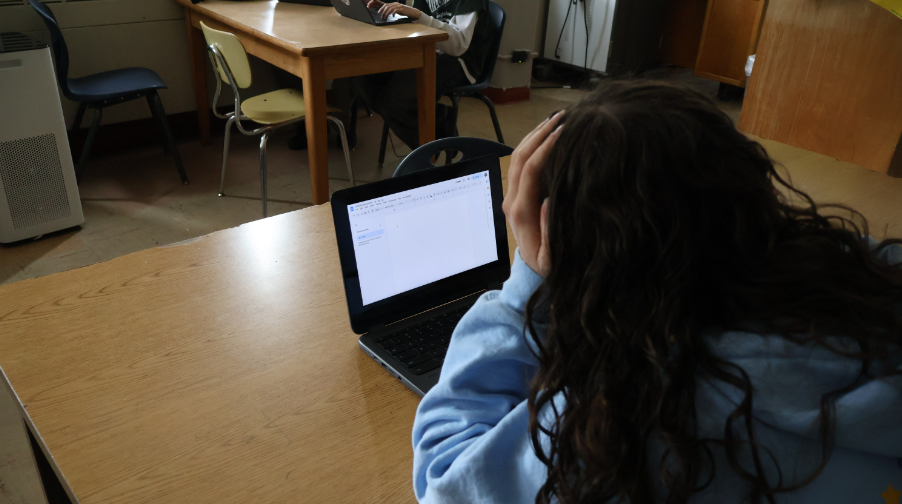
While writing an article, story or paper, many writers find themselves at an impasse and seemingly no inspiration to write. Their brains seem to shut down, and when they try to write, they completely draw a blank.
This common phenomenon is known as writer’s block, and can be very challenging for writers of all ages.
Writer’s block can be hard to define, as it varies from person to person and from mild to extreme intensity. It is described by Merriam-Webster Dictionary as “A psychological inhibition preventing a writer from proceeding with a piece,” essentially meaning it is the inability to move forward with your writing.
Jacoby Lundgren, a senior at Ida B. Wells-Barnett High School and co-president of Creative Writing club, describes it as having “so many creative ideas flowing through my head that I can’t keep track of what to write, to the…[point] that I burn out and I’m just looking at a blank page.”
Over time, writer’s block has become a prominent phenomenon; early Romanic writers experienced very little of it, but during the mid-19th and late 20th century, it quickly grew significantly and became a recognized entity. Today, it is a globally recognized phenomenon experienced by writers around the world.
Although it might feel like there is no reason or pattern to writer’s block, there are actually a few psychological causes.
The term “writer’s block” was coined in 1947 by Dr. Edmund Bergler, an Austrian psychiatrist living in New York City. He described the notion as struggling from a lack of incentive or inspiration, blaming it on milk-denying mothers.
However, psychologically, the true reasons behind writer’s block are motivational (fear of rejection), cognitive (perfectionism, problems caused by rigid thinking) or behavioral (procrastination), according to the 2019 paper written by Sarah J. Ahmed.
Perfectionism and procrastination often go hand in hand since perfectionism frequently motivates procrastination. Oftentimes, just the mix of these two traits can cause writer’s block.
During the writing and creative process, the frontal lobe, called the Broca’s area, manages language and comprehension. When there is damage to this area, permanent inability to form words can occur. Since writer’s block is essentially the short-term inability to form, and therefore write words, the Broca’s area has a clear relationship with the phenomenon.
In a 2013 study, participants were asked to write a story based off of the first 30 words of a narrative while in a fMRI scanner, a device that monitors brain activity. They were given two minutes to write their story afterwards, and the stories were scored based on creativity and measured against the brain activity seen while in the scanner.
The brainstorming and creative writing sections of the experiment showed that there were strong increases in brain activity in the frontal lobe, specifically the area that processes language. Additionally, subregions of the brain involving control and planning were activated throughout the brainstorming section. During the writing section, memory-related regions were activated, which are often tied to the physical act of writing.
This study shows that writer’s block may be more of a “creative block,” as many participants struggled to form connections between the brainstorming and the actual writing process.
In order to overcome writer’s block, common strategies to try include setting a writing schedule, rewarding yourself for your progress, splitting your writing into pieces or trying to read someone else’s writing for inspiration. Different solutions work for different people, so it’s important to try a lot of strategies.
Lundgren recommends listening to music to help cure writer’s block. “Almost every story I’ve written came from listening to a song or music as some sort of inspiration,” he says, adding, “I think that…the influence of someone else’s narrative gives a psychological realism and connection to me as a writer, because my brain’s clinging on to something I can relate to or apply to the story.”
Studies have also shown that going for a walk or exercising boosts your mental health as well as your creativity due to the increased blood flow to your brain, which is known to clear mental blockage and helps you focus.
For more ways to overcome writer’s block, visit this article from Purdue University. If you’re interested in learning more about writer’s block and studies done about it, visit this article from The Conversation for more details.