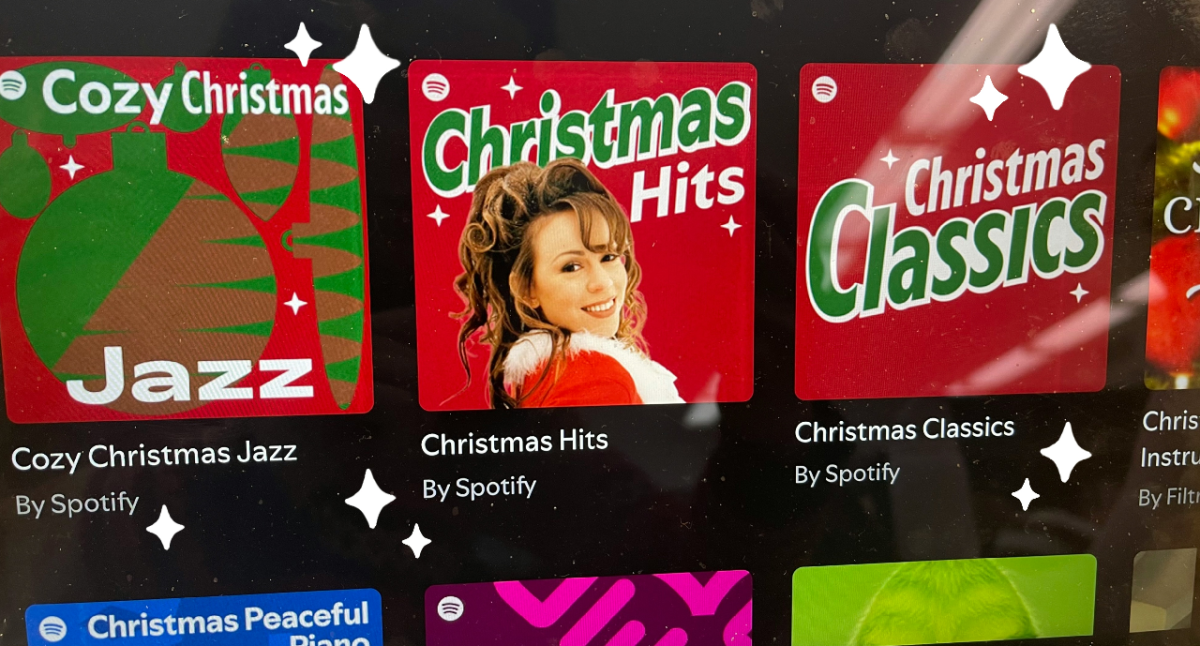
It’s the start of the holiday season. Nowadays, Christmas songs can be heard as early as November. On Nov. 1, 1994, the Pandora’s Box of Christmas music was unleashed upon department stores, grocery outlets and radio stations globally. This would otherwise be known as the release of Mariah Carey’s first Christmas album, “Merry Christmas,” with the hit song “All I Want for Christmas is You.”
With over 16 million copies sold worldwide, “All I Want for Christmas is You” dominated mainstream charts, remaining number one on the Billboard Hot 100 for over 18 weeks upon release. Carey has earned over $60 million from the song, which topped the charts every holiday season, peaking from 2019 to 2022 when it hit number one on the Billboard Hot 100 chart for four consecutive years.
In fact, this song became so revered for its massive streaming numbers and global influence that on Nov. 1, 2019, the singer started an annual tradition of posting herself singing her famous phrase, “It’s time,” to signify the beginning of the Christmas season and return of “All I Want for Christmas is You” to the charts. Later in Nov. 2023, Carey started a viral Christmas countdown, dubbing it as her “defrosting.”
While these numbers are without a doubt impressive, how did this song become so catchy and popular? The impact that Carey has had is monumental; it’s very rare to see a Christmas song remain in the mainstream year-round. But what makes Carey’s music so special that it marks the start of the Christmas season? If we peel back the commercial layers, what musical construction will lie behind the wrapping paper?
In an interview with “Vice,” Dr. James Kellaris, a composer, musician and Professor of Marketing at the University of Cincinnati, states that catchy songs generally exhibit three characteristics: simplicity, repetition, and incongruity.
The article focuses on how Baby Shark is a popular kids’ song that constantly rings in the back of your head because it’s so irritatingly catchy. However, many feel the same about Christmas music, with songs like “Jingle Bell Rock” and “All I Want for Christmas is You” all falling under the category of repetitive and simple.
Christmas music often incorporates many basic chord progressions and musical patterns. Nick Caldwell, who directs Ida B. Wells High School’s band, teaches AP Music Theory, piano and guitar, says “[Songs] become catchy because of chord changes and very common chord progressions . . .[such as] 1-4-5 progressions, or 6-4-5 progressions. Christmas songs don’t go too outside of the box as far as song construction, so they’re very palatable to everyone.”
Due to the broad range of singers, Christmas music can capture the festivity, lots of emotion and nostalgia associated with the holiday. Christmas music itself is like a brand, selling the product of happiness and family.
“Think about classical conditioning and how it’s used in advertisements,” says Norman Stremming, AP Psychology and anthropology teacher at IBW. “The brain will associate a brand and an item with an emotion, so when we hear these songs, the feelings of happiness, stress, melancholy, etc., are all amplified.”
If the science behind its construction wasn’t already enough to get Christmas music into heads, the fact that it’s played everywhere is. Especially with social media, holiday inspiration starts as soon as fall hits. The second Halloween ends, influencers get to work on advertising what to put on their wish list, unboxing advent calendars, decorating Christmas trees and doing festive celebrations. Christmas music is used as “sounds” or background music on TikTok and Instagram reels. Viral videos as early as the beginning of fall constantly discuss influencers’ favorite movies, songs and videos that honor the spirit of Christmas.
The holiday season seems to be starting earlier and earlier each year, and many can’t contain their excitement for this festive celebration. While some may argue that frequently hearing Christmas songs makes them catchy, others claim that the emotions and memories Christmas songs provoke keep them in your head longer.
“I think if [a song] has nostalgic value, it definitely helps me remember it,” says Zorina Johnson, a senior at IBW. “For example, whenever I’m singing Christmas music, I think of wrestling when we had Christmas practice, or when I was sitting by the fire when I was younger. Even with the Spanish [songs], I remember learning [them] in class.”
Part of what makes Christmas nostalgia so powerful is the range of emotions experienced during the holiday season. “I really like Christmas in general,” says Annaleah Wonder, a teacher of biology and chemistry at IBW and avid Christmas music listener. “I feel like people tend to be happier during the Christmas season, or at least the winter season and holidays in general. I think it makes people, or at least me, relive happy times and good memories of family and friends and get-togethers, snow, good food and all the amazing things that happen around the holidays.”
To reinforce this belief, Wonder cites the use of Carey’s famous song in “Love Actually,” saying, “‘All I Want for Christmas is You’ is popular because it was featured in ‘Love, Actually,’ which is one of the most popular Christmas movies for millennials. “So for it to be so big in that movie, I think [it] kind of also helped it to remain in the zeitgeist a decade after it came out. Additionally, because it was in that movie and people may associate that movie with good times ‘All I Want for Christmas Is You becomes happy,” says Wonder.
Nostalgic value for seasonal spirit plays an essential role in creating a catchy or memorable song, as well as overall popularity. But seasonal spirit can be a double-edged sword for some people, especially during the holiday season.
According to the American Psychological Association in 2023, “U.S. adults [feel] joyous but overwhelmed this holiday season, as nearly nine in 10 (89%) say that concerns such as not having enough money, missing loved ones and anticipating family conflict cause them stress at this time of year.”
“I think part of it, too, is that Christmas songs have a lot of nostalgia for people like childhood nostalgia, so I think people like listening to them if they had a good childhood due to that,” says Caldwell.
Christmas nostalgia is powerful because it fuels that care-free child Christmas spirit in a world of financial stress and conflict around the holidays. “[That’s] why [Christmas songs] also last for so long and maybe outside of just December, because of people’s memories around Christmas and family and all that,” says Wonder.
The formula for a catchy song, especially those revolving around Christmas, can be based on a fusion of musical strategy and nostalgic sentiments. As both of these shine bright in the Christmas music package, Christmas music causes humans to relive memories and think about that festive time in their lives where they wish they could return to or, on the other hand, escape from.