(Malia) I’ve often heard from the adults in my life that high school would be the best years of my life. Now that I’m living it, what I want most is to graduate and be free from my teenage years. Instead of finding myself, I feel more lost than ever before.
School has consumed me. I go to school, work on homework and college applications, go to the gym sometimes, eat dinner, scroll on my phone and go to sleep. And the cycle repeats. The whole time, school remains ever present in my mind. When I have free time, I often feel too exhausted to do the things I love and find fulfilling. Instead of spending time with friends and family, reading, or making art, I’m so tired mentally that I find myself scrolling endlessly or sleeping.
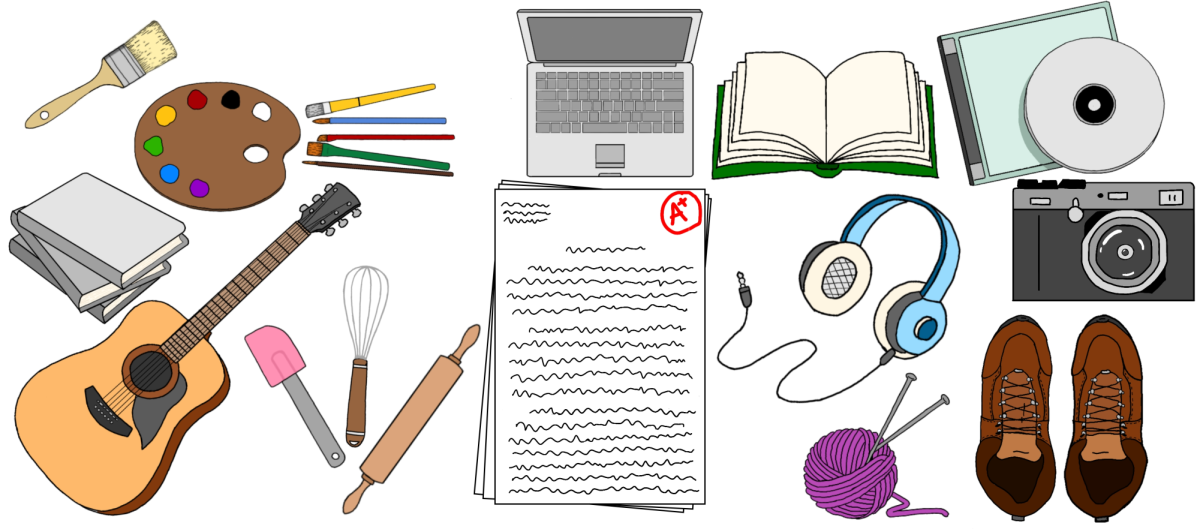
How you spend your time is a big part of what makes you, you. Or, at least it does for me. Reading, hiking, painting and listening to music are all core parts of my identity. By abandoning these to keep up with school, I’m also abandoning a piece of myself. What’s worse is that instead of making me feel accomplished, focusing only on school has made me feel worse than ever about my academic worth.
(Maggie) I used to spend hours drawing in my sketchbook, painting or writing stories. I regularly read 50+ books a year, taught myself new skills and went on deep dives on random topics I found interesting. There was a time when I could recite every country in the world aloud and point them out on the map. I loved to learn.
Now, when I have free time, it’s spent on my phone, watching TV or sleeping. While those aren’t inherently bad things, they don’t make me feel as happy or fulfilled as my old hobbies. I don’t spend extra hours memorizing the different flags around the world, or learning every U.S. president in order, or writing chapters of my own novel, like I used to. I waste my hours instead.
Cassidy Goodwin, a senior at Ida B. Wells High School, explains this phenomenon. “The sense of competition and constant pressure to perform that many academically driven students face may instill values like work ethic, but more often than not, they drive us to a place of burnout with little to no time to do the things they really love.”
Excessive academic pressure can also lead to issues like anxiety, depression and chronic fatigue, which make it even harder to spend free time pursuing a real hobby and not doom-scrolling.
(Malia) Growing up, I had such a strong passion for just the act of learning, whether it was in or out of school. I found math genuinely fun and would often complete problems in my free time, not for an assignment or a grade or to intentionally get ahead, but from pure enjoyment and curiosity. I mourn that version of myself who would research a random topic for hours or challenge myself with math far above my grade level.
It’s hard to pinpoint exactly where the shift away from this began or what caused it. However, I’ve found myself returning to this free, curious mindset during the summer break or during the rare times when I’m not overwhelmed with academic stress. I feel like these past few years have not only hindered my identity outside of school but also damaged my love for learning.
(Maggie) I spent so much of high school feeling like I was making the wrong academic choices, that I wasn’t pushing myself enough by taking a million AP classes and founding my own nonprofit—or whatever else is the new expectation for college applications. I worried about whether my transcript would look good enough to potential colleges. I dreamed about graduating and getting out of Oregon in hopes it would release some of the pressure I felt.
“You’re kind of told right off the bat, [that] you want to be a perfect candidate for colleges, and you’re not really encouraged to do the things that you actually like,” says Maia Weissfloch, a senior at IBW.
I am a 4.0 student, and that’s integral to my identity. My grades have always mattered a lot to me, and I have high academic expectations set for myself, by myself. It’s my senior year, and instead of taking easy, fun classes and free periods like my friends, I have a full schedule with five APs. And I hate myself for it.
My anxiety often presented itself in the form of personal academic pressure, and that caused procrastination, burnout and meltdowns. I never missed assignments. Everything was filled out with 100% effort. My homework piled up and I felt like I was drowning.
This was not sustainable. I was pushing myself so hard that there would be nights when I would break down, sobbing uncontrollably for hours. I would stay home from school the next day because I just didn’t think I’d be able to go, and then I’d have to make up what I missed. My workload just never seemed to lessen.
I was terrified of getting any grade under an A.
(Malia) I look back at times when I was working, playing lacrosse for over two hours every day, had 6 AP classes and was preparing to take the SAT, and wonder how I managed that. While I made it through, I think that version of myself was one of the most miserable. Now that my workload is lighter, I still find myself repeating my same old habits of doomscrolling and disregarding my hobbies. I often wonder why I still feel so exhausted from academics. Is it burnout? Senioritis? A phone addiction?
(Maggie) But with university cycles becoming increasingly competitive, how do students find time to enjoy non-academic activities among homework, jobs and responsibilities? It doesn’t just take decent grades and a nice essay to get into a good college now. The bar is unrealistically high.
“I wish there wasn’t so much pressure to be perfect for colleges, and I wish that there wasn’t so much fear mongering around ‘if you’re not doing all of this, you’re not gonna get into any college,’” says Weissfloch.
It’s also important to recognize that not everyone wants to go to a four-year university. Community college is a perfectly respectable option and should not be criticized or condemned as it might feel now. Between the media and family expectations, attending a two-year university can seem embarrassing or “less than,” when in reality it’s a smart alternative to save money, knock out prerequisites, and offer more time and space to figure yourself out if you aren’t already passionate about something.
Community college, entering the workforce, trade school and all other alternatives are okay.
Especially when you enter your junior year, it feels like high school is made to prepare you and send you off to college. While this is valuable, it’s also not what’s best for everyone and it often creates a lot of pressure and fear about the future. It forces students to make decisions about their lives and future, choices that many people just aren’t ready to make.
“I have often wondered: how many doctors were meant to be painters, and how many lawyers were meant to write? Is that the future I’ve paved for myself?” says Goodwin.
If you are facing similar challenges, remember that what you’re experiencing is not unique. There are so many people around you dealing with the same thing. It will be okay.