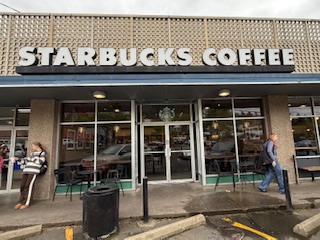
Starbucks started as a small coffee shop in Seattle in 1971, but over the decades, it has grown into a multinational chain. Known for good coffee and seasonal beverages, Starbucks was voted “No. 1 Best Coffee” in Zagat’s Survey of National Chain Restaurants from 2009‐2010. According to Starbucks’ quarterly report, they have 41,118 locations, 22,758 of which are international.
So, how did Starbucks get so big in the first place? The answer comes from a large combination of factors. The main reason was that they sold high-quality coffee, along with the beans, rather than the cheap instant coffee that Americans were used to.
Then, Howard Schultz, an American businessman, bought Starbucks in 1987 after being captivated by the environments and communities of Italian coffee shops. He worked hard to make Starbucks similar. People loved this idea, and soon, stores started popping up everywhere, even in Southeast Asia and Europe before 1998. At its peak, over seven Starbucks stores were opening worldwide each day.
Students at Ida B. Wells-Barnett High School are no strangers to the occasional Starbucks drink, but there’s more behind these treats than they may seem. So, you may find yourself asking, ” What’s so bad about Starbucks?”
“Businesses are able to maintain a certain level of quality as they grow… but eventually there gets to a point where they’re too big to sustain the same attention to detail that drives their level of quality,” says Tim Loveless, an AP Economics teacher at IBW. “I think that they probably lose sight of their reason for existing. It turns into more of a plot, profit-driven enterprise than a customer service enterprise.”
Starbucks kept growing, and its well-thought-out location placement was a huge factor in the company’s continued expansion.
According to an article by Spencer Rascoff on Quartz newsletters, Starbucks has a team analyzing data to find the most profitable locations for new shops. Starbucks locations increase the property value of surrounding neighborhoods, as housing near Starbucks is bought up much faster. In other words, Starbucks is fueling higher home values, not following them.
When an area has a Starbucks, businesses tend to crowd around it, making that area busier. Many people see this as a downside, that having lots of Starbucks can take away from a town’s uniqueness, essentially making every town look the same.
In addition, local businesses thrive on strong connections with their communities, but when a big company is in the way, it can be a pretty sizable issue. Starbucks stores tend to put down local coffee shops, causing many people to stop buying from them.
“It’s not the best coffee, but I have a Starbucks close to my house, and [there’s another] close to school. Starbucks is so close and convenient to have it there,” says Penelope Bringuier, an avid Starbucks drinker at IBW.
How does Starbucks source their coffee? The Coffee Chronicler talks about how Starbucks began a special reserve program in 2010, in which they maintain 100% ethically-grown arabica coffee beans.
However, in 2024, the National Consumers League (NCL) filed a lawsuit against the 100% ethical claim, saying “The company’s marketing misleads consumers and fails to convey the rampant sourcing from coffee and tea farms and cooperatives with a documented history of child labor, forced labor, sexual harassment and assault and other human rights abuses.” The legal battle is ongoing, and the NCL has brought up interesting evidence against Starbucks.
They also alleged that Starbucks was putting carcinogens in its decaf beverage. When independently tested, Starbucks’s decaf coffee had volatile organic compounds found traces of methylene chloride, benzene and toluene. It contained levels of these chemicals that the EPA deems unsafe for human consumption. According to Our Cancer Stories, toluene is known to cause headaches and dizziness, and chronic exposure can lead to brain damage. In response, a Starbucks representative said: “We take the allegations raised in the Williams and Strauss lawsuit seriously, but we firmly believe they are inaccurate.”
Starbucks’s expansion isn’t the only issue people have. For example, when the workers’ union surveyed Starbucks, they found that people of color were paid less than white workers. Starbucks also maintained its stores in Russia during the Russo-Ukrainian war in 2022, only closing after three months due to consumer backlash.
A 2023 CBS article details a federal labor judge who claimed that Starbucks violated workers’ rights “hundreds of times.” The article states, “[Judge] Rosas cited Starbucks’ egregious and widespread misconduct’ in his 200-page decision, which consolidated 35 unfair labor practice complaints at 21 Buffalo-area stores filed by Starbucks Workers United, the labor union organizing Starbucks’ stores. Rosas found that Starbucks had threatened employees, spied on them and more strictly enforced dress codes and other policies.” This excerpt highlights how serious some of the allegations against Starbucks have been.
“I think that most consumers, myself included, just care about the products that they get, not necessarily how they’re made or how they’re sourced,” says Loveless. This shows that we should be more aware of what goes into the products we buy, especially those we consume. Before shopping, make sure to research if a business tests on animals, where they source their materials and their environmental impact.
Another criticism Starbucks has faced in the past was over a tax scheme. According to BBC News articles, Starbucks paid zero dollars in corporate tax to the United Kingdom (U.K.) in 2011 while making sales just under 400 million. Starbucks executives said that they were “very pleased with the performance” of the U.K. business and that it was “profitable.”
Starbucks has been experiencing a steady decline in sales, indicating that it’s getting less and less popular. Coffee shops are still thriving, but people are getting less willing to buy pricier drinks.
It is up to each person to decide whether to support Starbucks, regardless of what others think. Although most students at IBW are unable to vote, choosing not to support big corporations can be a political action. Consider the facts stated in this article, and be mindful of Starbucks’s behavior.
If you want to avoid Starbucks, there are still a plethora of coffee shops in Portland. You can find coffee shop guides online, such as Oregon Essential and Double Skinny Macchiato.