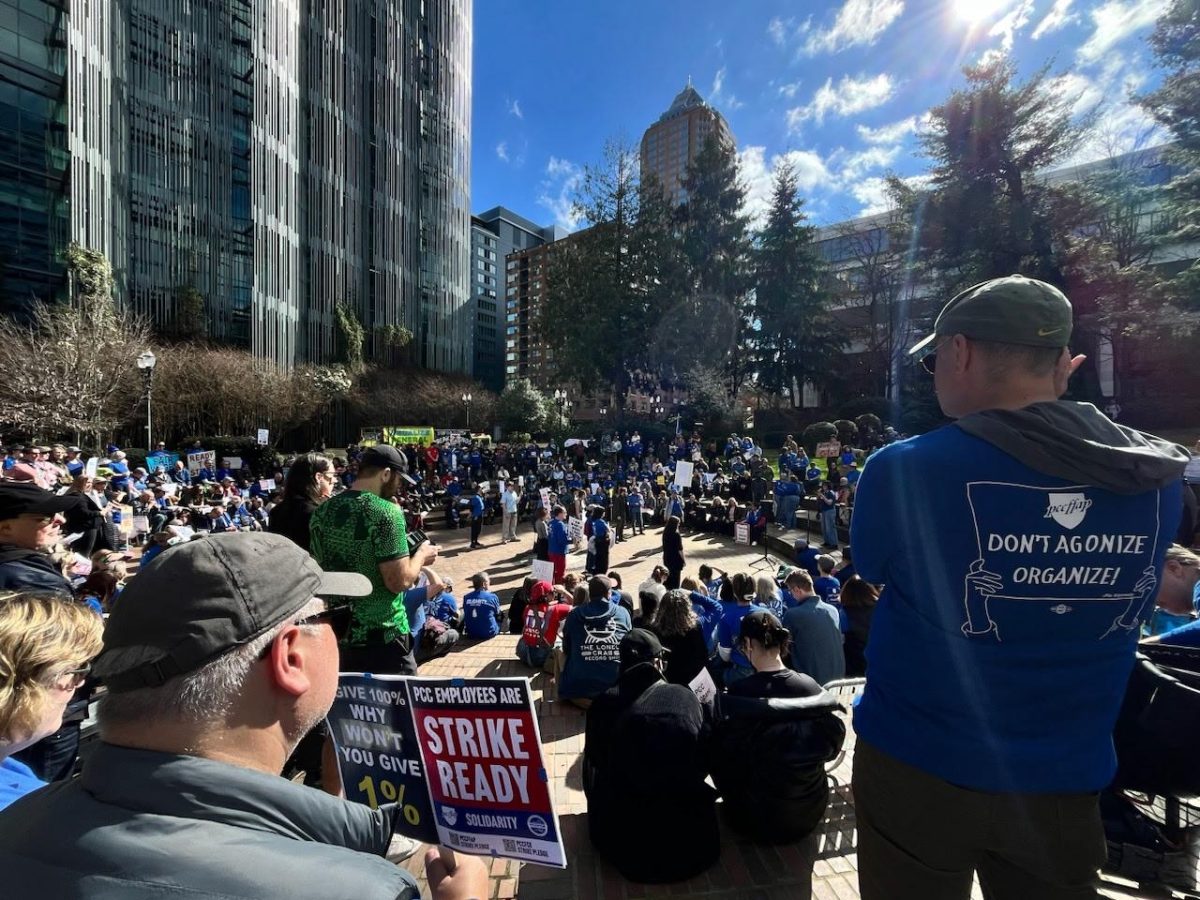
On Wednesday, March 11, Portland Community College (PCC) teacher and staff unions went on “the first community college strike in Oregon’s history,” according to the Oregonian. They bargained for a new contract regarding wages and other benefits for teachers. Lasting almost three weeks, the strike came to an end on March 30, 2026 when the unions reached an agreement with the PCC school board.
The PCC Federation of Faculty and Academic Professionals (FFAP) and Federation of Classified Employees (FCE) include teachers, accountants, academic advisors, groundskeepers, food service workers, IT support, marketing professionals and others who all went to the picket line and fought for better wages
While the two parties had been close to an agreement with the PCC school board for the last week of the strike, the final details came down to whether teachers should receive financial compensation for the time spent on strike. According to Willamette Weekly, “In the end, the union closed on a deal with PCC that doesn’t explicitly list backpay, but instead offers a lump sum payment to each member that union leaders said would effectively accomplish the same thing.” \
Specifically, “full-time faculty members will receive $5,475 in lump payments, academic professionals will get $5,000 and part-time academic professionals and faculty will get $1,400,” says OPB.
The deal also resulted in increasing pay for teachers by a certain percentage each year with a 2% cost-of-living increase this year and a 3% increase in 2026-27 according to Portland Tribune. “The agreement also raises the pay scale for part-time faculty from 75% to 76% of the full-time rate…”
The agreement increases healthcare coverage for faculty members, with full coverage being the most common tier and a new option for contributions to a health savings account.
However, one of the reasons that increasing pay for teachers is hard for PCC as a whole is due to recent federal cuts in education funding. With the uncertainty of how government funding will look in the future and general rising costs, increasing pay for teachers may mean cutting the money from elsewhere.
PCC President Adrien Bennings made a statement expressing gratitude for the agreement but recognizing future consequences. “We are pleased to be moving forward and refocusing on our core mission of educating students and serving our community,” said Bennings. “At the same time, our hearts are heavy because we know that this agreement is so far outside of our budget that it will result in significant additional cuts in the future.”
According to Inside Higher Ed, PCC is facing an additional $21 million in reductions for the 2021-2029 biennium in order to balance the 2025-27 biennium’s budget along with the $14.7 million in reductions they have already made.
As the strike happened right toward the end of PCC’s winter term, final tests, projects and inputting grades were delayed until they reached an agreement on March 30. This also created about a week-long delay in financial aid processing which couldn’t happen until winter grades were posted. The majority of classes in PCC’s spring term term have now been shortened by a week, creating a condensed 10-week spring term, which Portland Tribune reports caused most classes to begin on April 6 instead of the originally scheduled March 30. This puts into picture what drastic effects lack of educational funding has on students and faculty.
This reality not only impacts PCC, but is mirrored in community colleges across Oregon and the nation. Funding for these colleges both from state and federal sources isn’t up to pace with what the institutions need to fund quality education. While it’s certainly worth celebrating the agreement between the FFAP/FCE and the PCC school board, it’s important to recognize that this isn’t the end of the sacrifices students and teachers across Oregon will have to make due to budget shortfalls, and continue to fight for better educational funding.