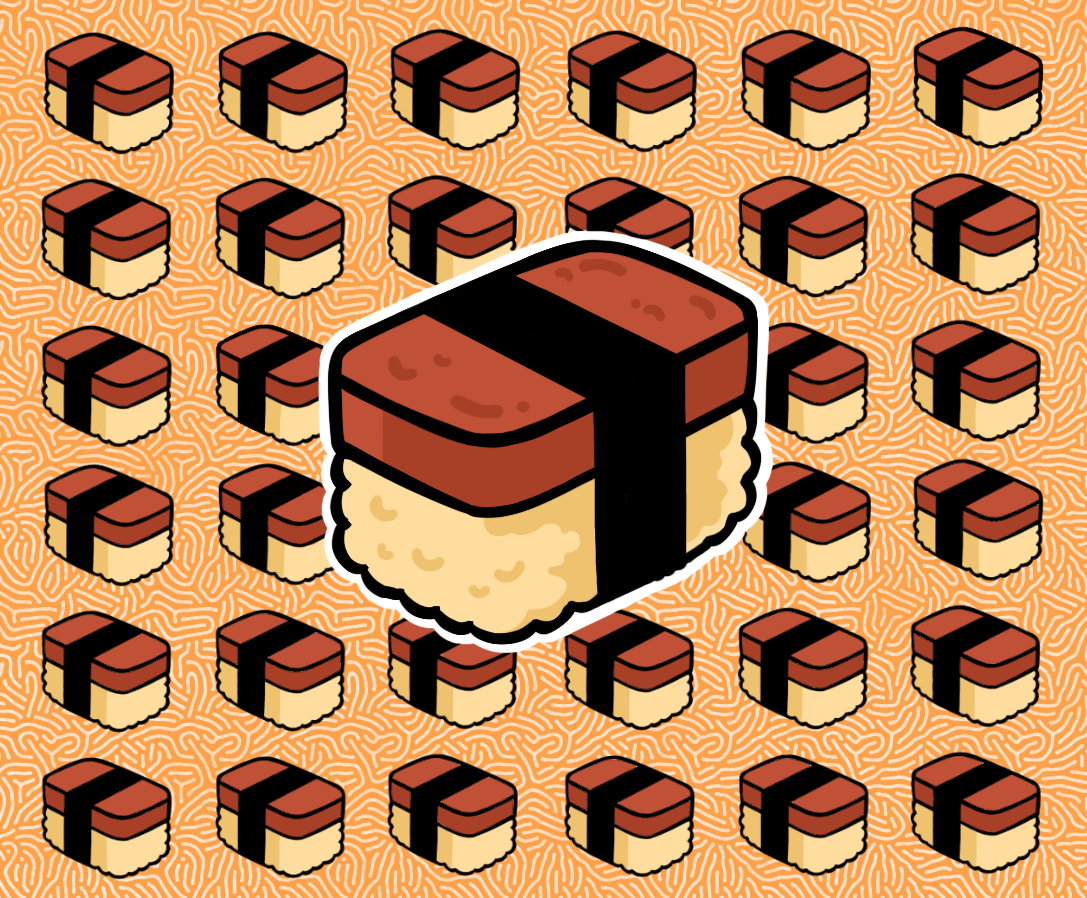
SPAM musubi is one of the most iconic symbols of Hawai’i. It can be found on any corner of the islands—the 7-11 convenience store, the mom-and-pop store down the road or in your auntie’s house next door.
The snack consists of grilled SPAM and a block of rice, sandwiched together with nori and often seasoned with teriyaki or soy sauce. It is also common to see people add their own take on it by adding toppings like egg, Portuguese sausage, avocado and much more.
Barbara Funamura, owner of Kaua’i restaurant Joni-Hana, is widely credited as the originator of the SPAM musubi in 1983.
But before the beloved dish spread throughout the Hawai’ian islands and the United States, the main component of SPAM still served as a reminder of many Pacific Islands’ experiences with colonialism.
Japanese immigrants arrive in Hawai’i
The islands of Hawai’i are also known as the “melting pot” of cultures, home to many Asian populations, as a result of labor recruitment for plantations in the 19th and 20th centuries.
In 1885, Japanese immigrants began arriving in Hawai’i to work on sugar plantations. With them, they brought their histories, values and practices. One of the most widely known culinary practices Japanese immigrants brought with them was sushi, like Onigiri and Nigiri.
Onigiri is a triangular ball of rice, molded around a filling in the middle, such as salmon, konbu or umeboshi, wrapped in nori. Nigiri is simpler, consisting of a mound of vinegar rice topped with raw fish or seafood.
These Japanese sushi styles would later influence Funamura, a Japanese-American born in Hawai’i, to create the SPAM musubi we know today.
World War II begins
SPAM is a brand of American lunch meat made by Hormel Foods Corporation. It is mainly a mixture of processed pork and ham that took off worldwide during World War II.
According to PBS Hawai’i, SPAM was first introduced to Hawai’i in 1937. It was used as a shelf-stable food for troops stationed there.
People across the islands quickly began using SPAM as a source of protein in meals when meat was scarce during the war. After World War II ended, SPAM established itself as a staple cuisine of the Hawai’ian islands.
Land stripped away
During and after World War II, many natives in the Pacific Islands, like the Chamorro of Guam, were stripped of their lands by U.S. forces. Their livelihoods were built on farming, fishing and hunting. No longer having control over their food supply, the Chamorros had to turn to SPAM.
For the natives of Hawai’i, colonial influences on their homes began much earlier, as the islands were annexed by the U.S. in 1895.
Funamura’s kitchen
A little under two decades after World War II ended, Funamura created the SPAM musubi we know and love.
In her restaurant, Funarmara sold sushi. For some workers, it was difficult to make the sushi with the traditional, wooden sushi roller. To alleviate this, a rectangular mold was made, giving all workers the ability to make the sushi Joni-Hana sold.
It was soon discovered that a rectangle of SPAM fit perfectly in the mold. This led to the creation of the Spam musubi in Joni-Hana. This snack quickly reached the islands outside of Kaua’i, taking Hawai’i by storm.
A symbol of pride and colonialism
Hawai’i consumes the most SPAM per capita, with Guam coming in a close second. For many in these islands, SPAM is a source of pride. They hold events like SPAM Jam in Waikiki, Hawai’i and Spam cook-offs in Guam.
“There are Chamorros who view SPAM very emotionally, like when they see a can of SPAM, and they’ll get choked up,” Anne Perez Hattori, a history professor at the University of Guam, told Al Jazeera.
But the introduction of SPAM to the Pacific Islands coincides with diabetes, cancer and heart diseases skyrocketing in those regions. The diabetes rate in both the nation of Guam and the population of Native Hawai’ians is double that of the U.S.
Jamie Suehiro is the advisor of the Asian Desi Pacific Islander Club and a staff member at Ida B. Wells-Barnett High School. She was born and raised in Hawai’i before moving and working in Oregon.
Suehiro also shares a sense of pride when thinking about SPAM musubi. But she says she considers the contextuality, too. “In some ways, it is a form of resistance. In other words, appreciation for the people who could turn what they had into something delicious,” she said. “Yet it’s also colonizer food.”
SPAM musubi eventually made its way to the mainland of the U.S., becoming a symbol synonymous with the culture of the Pacific Islands, Hawai’i in particular. “This is the lesser-known, more complex aspect of many popular foods,” said Suehiro. “There’s a lot of layers to it.”