In the past decade, recent federal testing data has revealed that student’s reading and writing comprehension levels have reached a new low not seen since 1992. This significant decline, while at first glance seems to be a result of the COVID-19 pandemic. But in reality, literacy scores have been steadily declining since 2018, which is before COVID-19 hit. So, what is the true reason for declining student illiteracy?
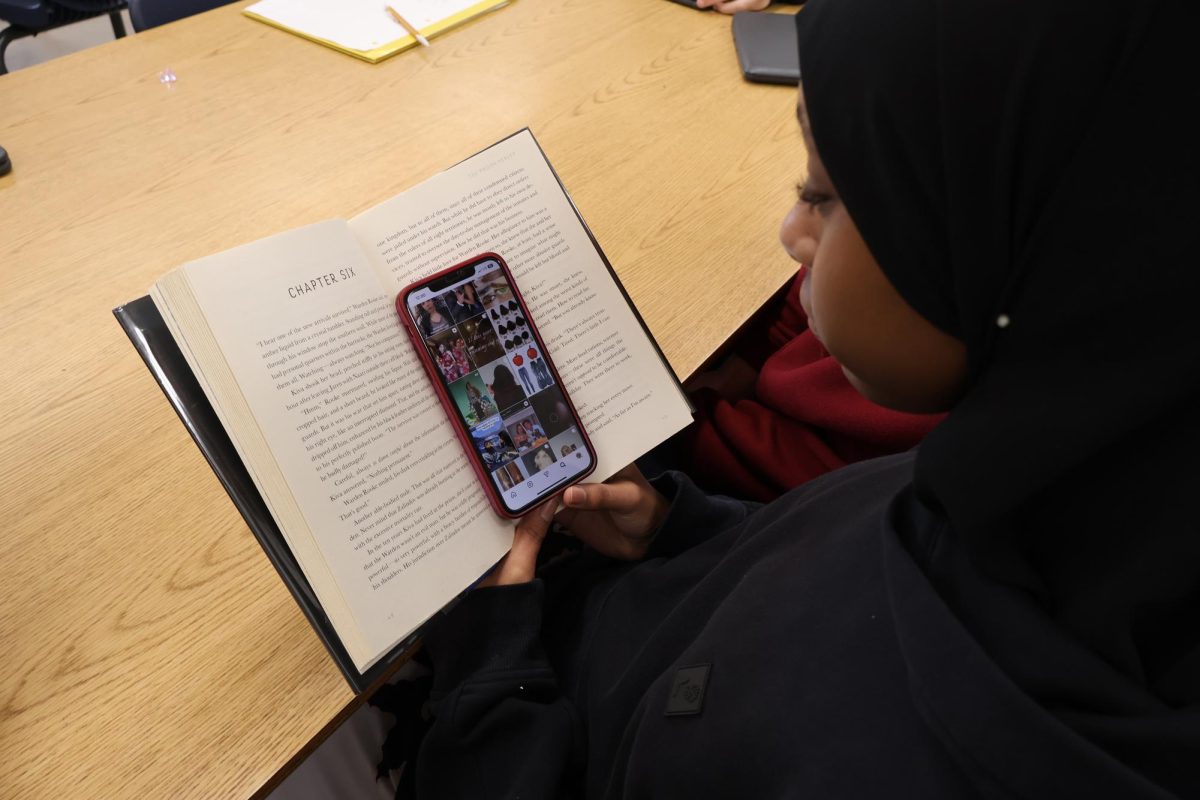
Professors at Harvard suspect that social media and increased phone usage play a significant role. Martin West is the academic dean, deputy director of the Program on Education Policy and Governance, and professor of education at Harvard Graduate School of Education. He argues that social media gives young people instant gratification that cannot be obtained by reading. “That ability to distract, to compete for attention, could also lead to diminished appetite for persistence in reading on their own,” he said in episode 15 of the podcast “Harvard Thinking.”
Furthermore, social media has been shown to lower attention spans and engagement in school work and hobbies. In 2004, research revealed that the average amount of time spent on a screen was two and a half minutes. However, by 2023 it was down to 40 seconds.
While COVID was not the original cause of decreasing literacy, it did play an impactful part. The pandemic made screens a necessity; with growing reliance on technology for communication, teens who were in online school during the COVID pandemic found themselves increasingly dependent on their phones.
Because of declining attention spans, many students don’t even have the patience to read long texts. This leads to students often relying on Artificial Intelligence to summarize texts so they don’t have to read it themselves.
The struggle with technology overuse in teens also caused a huge shift in how many young people spend their free time. Instead of reading or pursuing a hobby, the majority of teenagers use their time to scroll on social media. In 13-year-olds, students who read for fun went from 27% in 2012 to 14% in 2023, and rates continue to decline, according to NAEP testing data.
Danica Fierman, an English professor at Portland Community College, feels that reading and writing have begun to feel less like a fun activity and more like work since students are assigned many reading-based assignments in school. Fierman said, “The sheer number of texts that were assigned meant…they had to spend their time doing required reading that they weren’t…excited about, and then it didn’t make them want to read in their spare time.”
“I hear faculty saying they assign less reading, and they try to…cover all the topics in the lecture, instead of expecting students to read, which means that then…their class can’t practice the materials,” Fierman says. “But I think there is a point at which [we] as faculty, could…find other ways besides being punitive, besides punishment, to help people navigate the reading of their text.”
Here at Ida B. Wells-Barnett High School, Portland Public Schools is taking measures to keep students focused. At the beginning of the 2025-2026 school year, IBW teachers and administration effectuated the district-wide cell-phone ban by introducing Yondr pouches, that students lock their phone inside of each morning and unlock after school ends. Their goal is to minimize distractions and keep students on task during school hours.
Within PPS, Yondr pouches have been the most commonly implemented tool for the cell-phone ban. But, some other districts focus on teaching early reading and writing techniques for kindergarten through 3rd grade, putting lots of money into high-quality materials for school, or offering literacy coaching for students.
The National Assessment of Educational Progress (NAEP) conducted tests in early 2024, the first of its kind since before the COVID pandemic. Matthew Soldner, the acting commissioner of the National Center for Educational Statistics (the arm of the federal Education Department that distributes the tests), said that the results point to “a stark decline” in student performance.
So what can be done differently to prevent this? The decrease in literacy rates has been a problem for centuries, but new factors like technology and COVID constitute a new era in this decline. Some of the issues that need to be addressed include training teachers so they can better support their students, helping students get back on track after the education they lost during COVID, and decreasing constant distractions from technology.
Phil Capin, an assistant professor and reading researcher at Harvard Graduate School of Education, wonders if these testing scores haven’t just been declining recently, but if they have been too low over the course of the test’s history.
“I guess I’m trying to point to this idea that scores have declined in the more recent years, but I would say that the scores have been relatively stable over time and not high enough,” he says. “And so I think we should wonder whether we’re OK with that. Are we OK with about a third of students performing at what the NAEP considers to be the basic level?”