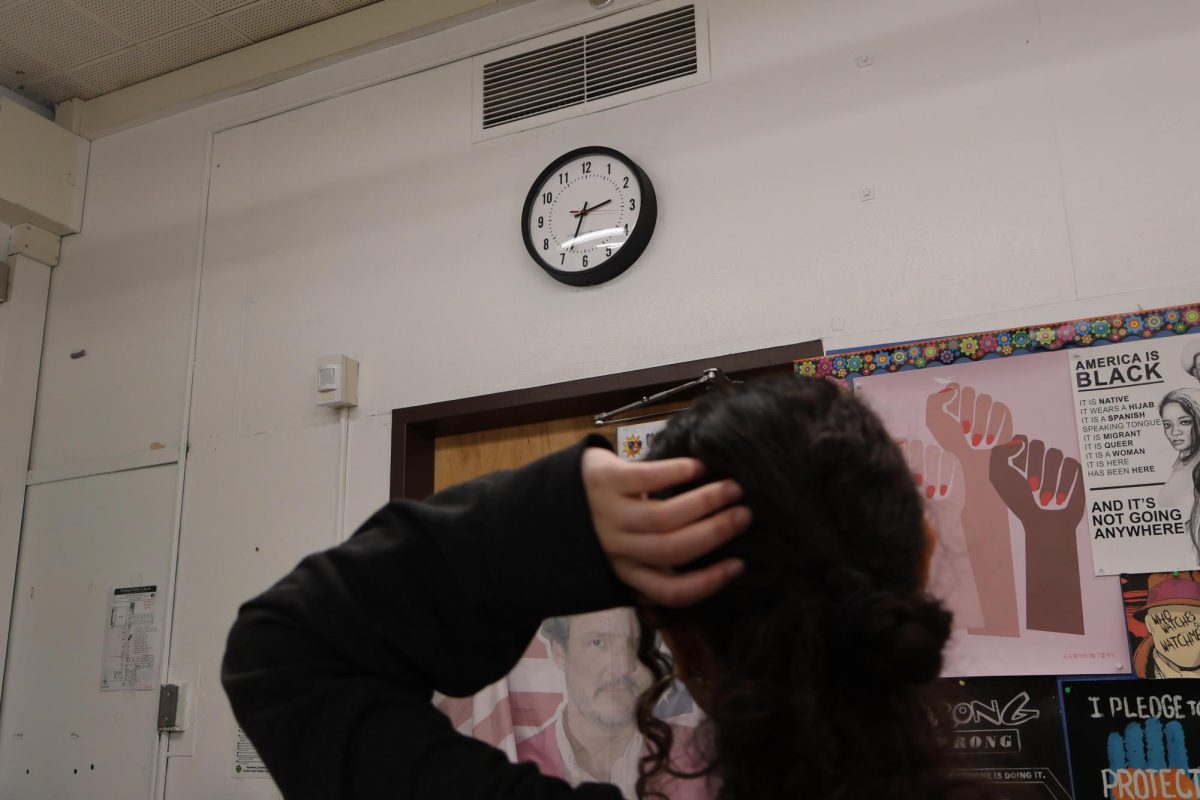
Imagine it’s nearing the end of class. The clock above reads 3:29 p.m. Assuming there’s only a minute left, you pack up your stuff and go to line up at the door.
As the second hand ticks past 3:30 p.m., you recall that the day now ends at 3:34 p.m. Though it’s a seemingly small amount of time, it feels like hours to you as you wait. Meandering your eyes around the room, all of your peers seem to be entirely packed up too, despite being aware of the schedule reality.
It feels like such an insignificant amount of time, one that you question the importance of. But why was this change implemented in the first place?
Up until two years ago, excluding half days and other special scheduling days, the school’s start and end times were consistent: 8:30 a.m. to 3:30 p.m. every day. That was until an extra four minutes were slotted in, specifically in the second and sixth periods of the day, making it 8:26 a.m. to 3:30 p.m.
This decision had substantial backlash when it was first made.
“Last year sucked with that, because the bus schedule didn’t change and so sometimes you would be late and it wouldn’t be your fault. It would literally be the bus is on its later time for arrival,” said Adaya Smith, a senior at Ida B. Wells High School. “Those four minutes can make a real difference.”
This 2025–26 school year, it changed again, to 8:30 a.m. to 3:34 p.m. The starting time reverted to its previous time, and the four extra minutes were shifted to the end of the day.
“I think [the second change] was people pushing back on starting earlier in the day because 8:30 sounds like such a clean number, versus 8:26,” said Rebecca Belknap, a learning specialist at IBW. “I think people just didn’t like that. I think there [were] a lot of kids still just showing up at 8:30.”
If you were a new student at IBW, it wouldn’t have too much impact, but current juniors, seniors, and even sophomores have felt the effects, along with staff at the school. It makes a significant impact on how people navigate the day.
Many students had gotten used to the previous schedule, leaving them showing up late when they otherwise wouldn’t, or their transportation (mainly buses) would still be on the old schedule.
Then, the second they got used to the change, it switched back. This disorientation echoed to parents/guardians of students, educators, staff members and other involved community members.
“I find it really disturbing that it is not a full five minutes,” said Lilah Paul, a junior at IBW. “I found it really hard to adjust to. I am a person of routines and that messed my routine up for two years in a row.”
This sentiment also echoes the thoughts many other students have voiced.
There are conflicting explanations as to why this change has been made being tossed around. “I’ve heard more than three teachers say that it was because of morning announcements, but [the announcements] never actually take four minutes…and you can’t actually hear any of it,” said Paul.
According to Ayesha Coning, Principal of IBW, “In Oregon we are required to have 990 instructional minutes, and in order to make time for announcements… We had to add 4 minutes of instruction…That is a requirement by the Oregon Department of Education, and we are right at that [amount of time], every minute counts.”
While this is just one schedule adjustment, these kinds of small changes have been happening more often than would be expected.
“It feels like every year the schedule changes slightly,” said Belknap. “We previously had five minute passing periods and they’re now seven…so it feels difficult because every time we show up in August it feels like ‘oh here’s the new schedule’ and it’s something different than the previous year.”
Though the schedule changes might be made in pursuit of better support for students and educators, these issues call into question whether the frequent changes are hard on people’s brains, especially when high school students already have so much on their minds, both in their academic and their personal lives.
“I would like it if they started at 9:00 or 9:30 instead, so that we could sleep in because of the whole teenagers’ sleep schedules and whatnot,” said Smith.
Hopefully, if any extra edits to the schedule are done in future years at IBW, they are done to benefit students and staff. Or, even better, this finally could be a good middle ground where other adjustments aren’t needed. It’s just up to whatever the future brings to Ida B. Wells High School.